Mary Kunz Goldman was for over 10 years the classical music critic for The Buffalo News, the daily paper of Buffalo, N.Y. She is also the authorized biographer of the great American pianist Leonard Pennario.
I am coming to a new appreciation of the psychedelic classical music album art of the 1970s.
Part of that is from my Etsy store. These records go in and out of my life. But it is also true that they bring back memories.
Mozart's Greatest Hits.
I sold this one out of my shop not long ago. It was factory sealed. That was not my copy! My own personal copy has been played a million times.
There is this gem. I have this album and will be listing it tomorrow, I think.
Is that amazing or what? I part with it reluctantly. But I price my albums high enough so that they take a long time to sell. So with luck I will have years to enjoy this.
Then there is the great Mozart album at the top of the post. I have this album myself but I recently came into possession of a second copy and that one is for sale.
I have learned that the Mozart Serenade art was the work of the great Sandy Hoffman who is one of the artists rightfully lionized on the site "Groove Is In the Art."
That site also includes this gem.
And this masterpiece by Sandy Hoffman for a Shostakovich record. He was the greatest! Hoffman we are talking. Shostakovich was great but let us admit it, in this case you could argue that he could not hold a candle to his album art.
All this takes me back to when I was very young. My parents took us to some kind of toy sale and there was a coloring set featuring drawings from "The Yellow Submarine." I went home with it but I had no idea what "The Yellow Submarine" was and though I colored the drawings they kind of creeped me out.
Now I look at these things differently.
What a wonderful world of color and music!
You have to keep your eyes open when you go to Goodwill.
Somehow "Walkure" has become one of my sacred cow operas, one of a handful that I am very particular about. I think it began when my sister and I went to Toronto and saw it at the Canadian Opera Company. We had lost our dad not that long before that and we were totally not ready for what Wotan's Farewell was going to do to us. All through that final scene we cried and cried, passing a single soggy Kleenex back and forth. We were still crying as we left the opera house.
Because we were so undone we went for a glass of wine, and we spied Wotan and Brunnhilde a few tables away, quarrel forgotten, eating Buffalo wings. How could you not cheer up, seeing that? Now I think I would go up and say hello, say something. But I was shy then.
Anyway, I come to this opera with a lot of baggage. The good news is, I was drawn into what I saw yesterday. I got a kick out of Greer Grimsley's Wotan. He has a mighty fine voice, and with his looks and his manner, he puts his own spin on the part. An American spin, I want to say, though I know he is from New Orleans, a city I love, and the power of suggestion is strong. He looks like a handsome biker. There is this quick clip from "Rheingold" --
-- that I found today and adore. You can really see his personality there. That rakish smile, irresistible. And a creative take on the part. Jamie Barton, as his wife, is a kick too but maybe too much, a little too funny. You have to watch it. Seeing this gives a new dimension to "Walkure," where these two singers are together again.
In "Walkure" things are less sunny with these two and he is more world weary, as Wotan should be. I loved him, how can you not? But he does not yet have the overwhelming .... can I use that cliche word gravitas? It makes me laugh but maybe I have to ... that Wotan should have, that the big Wotans of history had. The big Wotans of history. They cast a long shadow, terrible to any singer these days. I do not envy present-day Wotans, I will tell you that right now.
You have big powerful supermen like Hans Hotter. He picks Brunnhilde up in his arms as if she is nothing. Just doing what needs to be done.
As does Donald McIntyre, here with the beautiful Gwyneth Jones.
(You do not want to know how long I wasted on YouTube today.)
That last clip, from a Bayreuth production, really got to me. They just took it to the wall. The sweat and tears on Wotan's face, the intensity and drama. The flames and the smoke.
That brings me to a problem I had with the Met production. The staging was too complicated. They had this set of sort of seesaws -- I think they used that word -- that was supposed to stand in for the Valkyries' horses, or something. It did not work, at least from where I sat. Maybe if you were at Lincoln Center the seesaws worked better. To us in the movie theater they just looked like seesaws.
Not only that but at intermission we had to try understanding how they worked. They had stagehands explaining them. If there is one thing I hate it is someone trying to tell me how they stage something, how a movie was made, anything like that. Now when I watch the actual production I am thinking about how they did it. What a pain.
And for what? There was one cool scene that had you looking down on Brunnhilde as if from above. I think that is it at the top of this post, though it is hard to make out. But otherwise the last scene could have been staged a lot better. And as Brunnhilde settled into her resting place, it looked for a moment as if she were pitching backwards. You do not want that.
You want flames and smoke. It is not rocket science. Wagner will do the rest.
Well, at least this production was not horrible like this other one I wrote about this other time. Let us hash over the other singers. Brunnhilde (Christine Goerke) was too cartoon-ish for me at the start but I warmed up to her. There is this haunting scene when she appears to Siegmund as a portent of his death. The music grows trance-like as she tells him who she is and what her appearance means. There is a moment when he meets her eyes, sealing his fate. Goerke was lovely in that scene, just devastating.
Tomorrow I will research other singers singing that scene. There go another five hours, you know?
Siegmund and Sieglinde, I liked them both. Sieglinde was just beautiful, I mean she looked the part. Eva-Maria Westbroek, her name is. She was glorious.
And in the all-important role of Hunding, Sieglinde's Neanderthal husband -- a part I love, and that my father loved before me -- was ...let me check ... Gunther Groissboek. I am a complete Gunther Groissboek fan from this moment on. He has this marvelous voice and he knows how to use it, which is often out of a corner of his mouth. A spectacular Hunding, spectacular.
"Badass," I whispered to my friend Nisha, sitting next to me, between me and our friend Meghan. I am privileged to have not one but two friends willing to spend five hours at "Die Walkure."
One touch I loved -- it might be in the script, who knows? -- is how Hunding hangs his Neanderthal furs on Nothung, the magical sword stuck in the tree.
At intermission Grossboek confided that he had been tapped to play Wotan at Bayreuth. Do it. Do it! But at the same time I would also like to see Greer Grimsley tackle the part at Bayreuth. In another year or so he should be ready. He is 62 now but as Wotans go that is young.
I have multiple careers I will be following thanks to this production.
Today I got word that the Los Angeles Philharmonic is featuring Pennario in an upcoming exhibition!
This is great news. As I told the L.A. Phil staffer who reached out to me, Pennario was always proud of his association with that orchestra, ever since he made his debut there at 14, under the baton of the great Otto Klemperer.
The featured performance comes from the Los Angeles Philharmonic's archives and is of Beethoven's Triple Concerto. This makes me very happy because Pennario never made a record of this particular piece. He performed it only a handful of times -- three or maybe four, not more than that. Pennario was funny that way. It was totally normal for him to do a concerto only once or twice in his life, on demand. He had that capability.
I will present the rest of the details as they reach me. Either that or I will present them tomorrow when I have occasion to look them up in my overstuffed files. I was ready just now to start guessing who the two other soloists are in the concerto, but just so as not to confuse things, I will get the facts. This concert is on file somewhere in the other room and I will be able to tell you the who, the when, and the where, if not the how and the why.
This exhibition must be part of the orchestra's celebration of its 100-year-anniversary. They must be looking back on highlights.
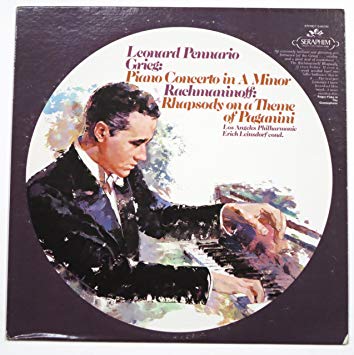
What a lucky group of musicians to have Leonard Pennario living right in their back yard, and soloing with them on a regular basis. And to record with them, too, on multiple occasions. That fine record at the top of this post featured Pennario playing Rachmaninoff with the Los Angeles Philharmonic and conductor Erich Leinsdorf.
It starts out with Pennario's sweetly haunting performance of Fritz Kreisler's "Liebesleid" and goes from there.
In between the selections there are beautiful voices speaking in French which, je ne comprends pas, but I hear the name Leonard Pennario spoken and that is enough for me.
The French have a beautiful way of saying Pennario's name. "Lee-o-NARD Pennario" kind of comes close. That actually makes me laugh because this Italian historian here in Buffalo, Joey Giambra, he has been known to refer to Pennario as "the Nard" or "Nardu."
I have listened to the first installment and moved on to the second, which begins with Beethoven's "Fur Elise" and moves on to the Schumann Piano Concerto. No one in the United States would ever play Pennario playing Schumann.
Zut alors! I wish I could understand French better.
Pennario would have been able to understand it, no problem.
Oh well ... It is the thought that counts. I will be returning to this podcast, or whatever it is, with great pleasure. I will report on it.
I have been studying up on art and illustration and several artists and illustrators are emerging as my favorites. One is the British illustrator Arthur Rackham.
The name was new to me, I have to admit. But he is a recognized great and has been for a long time.
Talking about "Die Walkure" yesterday I seemed to recall reading that he had illustrated Wagner's "Ring" cycle. And sure enough.
You could fill whole Pinterest boards with this stuff and believe me, I will. But meanwhile ...
This appears to be Brunnhilde pleading with Wotan/
And the Ride of the Valkyries. Zowie!
I would guess this is Brunnhilde doing some soul searching.
Dover Publications has put out a book of Rackham's Wagner illustrations which I just pinned on Pinterest on a brand-new board I have titled Art Books I am Craving.
No wonder artists love Wagner. What images. Anything you want to paint, you can paint! It is all in there somewhere.
I do not know for sure that all visual artists love Wagner. But I have an ongoing list and so far the list has two biggies, both favorites of mine -- Pierre Auguste Renoir and John Singer Sargent.
Renoir painted Wagner's portrait.
If it looks a little funny it was a year before Wagner died and I do not think he was feeling too well. But I love the colors in the background and it does give you a sense of vivid imagination, both on the part of the musician and the artist.
One may while away hours contemplating such matters.
Having gone to see the "Carmen" simulcast a few weeks ago I am psyched for "Die Walkure," coming up on March 30.
That is a picture I found from it up above. Where are the horned helmets??? I do not see any.
I want horned helmets!!!
Well, I am sure they will be in there somewhere. Meanwhile I will have to work out the logistics. I have not made up my mind between the Saturday performance and the Wednesday encore simulcast. Saturdays can be dicey because of prepping for church coffee hour. But perhaps I can swing it. There is ...
.. about seeing the simulcast when it is a simulcast, when the opera is going on in real time at the Met in New York City as you are seeing it.
Plus, I will tell you one thing, I want to enjoy these simulcasts while we have them.
When we went to "Carmen," which I never did report on, the theater was empty. And I do not mean for the opera. For the entire theater!
There was nobody anywhere!
Approaching the Elmwood Regal Cinema, I thought the place was closed. It did not look open. I have not gone to the movies recently, because although I try to keep up with what is showing, there is nothing really I want to see. But it was not that long ago that I was going to movies. I reviewed a lot of them for The Buffalo News. That was only a couple of years ago. The place would be packed.
Kids must not go to movies anymore. And it was not that I was early, either. "Carmen" let out about 10 p.m. and there was nobody there then, either.
How do they keep the theater open?
My friend Meghan and I were just about the only people in the place!
Anyway. To go to "Walkure" you have to be something of a major opera fan because it is quite the commitment. I am lucky to have a few friends who want to go. Not that it would be a problem going on my own. I have gone to many movies on my own in the line of work and I could easily do it again.
But I feel blessed to know people as whacked as I am -- that is, whacked enough to commit to four hours or whatever. Here is the sked from the Met website.
House opens.
Act I, 65 Minutes.
Intermission, 39 minutes.
Act II, 90 minutes.
Intermission, 35 minutes.
Act III, 66 minutes.
Opera ends.
How about that? It adds up to four hours 55 minutes.
Five minutes short of five hours!! I guess when I invite extra people along I should warn them.
It is highly subjective! I get a kick out stocking it. And I have learned a lot from working on it over the last several years. The history of records is the history of music. It has helped me in my research of Leonard Pennario, the great pianist I am writing my book about. I know all the years that Pennario's records came out, first on Capitol, then on Capitol / EMI, then on RCA Victor, and then back at EMI, on Angel Records. I love seeing what was going on at the same time his records emerged. I am fascinated by the record business and I love seeing the big picture.
And every once in a while you run across something really cool.
For instance today I listed this beautiful record of the Rossini-Respighi ballet "La Boutique Fantasque." I love the music of Respighi. As I wrote in the description of the record, he has the most beautiful way of re-imagining the melodies of an earlier era. That is only one of his skills but it is something I have always enjoyed. Another skill is, his orchestration is so colorful. He really knew how to use all the different instruments. A master orchestrator.
This album offers something extra special -- that great mid-century cover.
That yellow cover! That gentleman in the top hat bowing! The ballerina with the pigtails!
Can you beat it?
Now I am going to really nerd out. There is the matter of the dust sleeve.
Even as a Capitol Records enthusiast, I had never seen this particular dust sleeve before. The dust sleeve clearly dates to not long after EMI acquired Capitol Records, which it did in 1955, because the notes spotlight the acquisition. The very British performance from 1957 features the Royal Philharmonic Orchestra and Sir Eugene Goossens and the notes on the dust sleeve make a big deal about the Abbey Road studios, explaining that Abbey Road is a nondescript street in the London neighborhood of King's Cross. It would still be a few years before the Beatles made the name famous.
EMI was obviously very proud of the Abbey Road studios.
The label too was something I had never seen before. It was Capitol's famous rainbow design but also snazzy lettering reading "Capitol EMI." The "EMI" looks like a lightning bolt. Clever! Maybe this design was used a lot but all I am saying is, I had never run across it.
This record captures a particular moment in time. That is what I love about vinyl. That and, it is such a delight to behold -- the cover art, the record itself, the packaging, everything.
I could tell that Howard was tuning me out as I trailed after him from room to room this morning trying to call his attention to the greatness of these matters. Howard, look at this dust sleeve!
Now the damage is done. I do not want to part with it.