Thursday, December 25, 2014

On the first day of Christmas


 At Mass today we got to sing the medieval chant "Puer Natus Est in Bethlehem." I was able to find it on YouTube, sung by the Monks of Santo Domingo de Silos.

Such a beautiful melody! The chorister next to me pointed afterward to the date of the music. It is from the fourth century.

This is the reason I get myself up early on Christmas morning, which trust me is not easy. Getting up is worth it to hear beautiful music. To be able to sing timeless chants, thousands of years old. We got to sing four verses of this chant and when it was over we all kind of sighed.

So beautiful!


Saturday, December 6, 2014

A Met tenor meets a theater organ legend

Listening to theater organ legend Jesse Crawford today I went foraging on YouTube to see if I could find the Christmas music that was on the records I was playing. And I found a performance he gave in 1929 (I think) with the tenor Richard Crooks.

That is a name widely forgotten today, Richard Crooks. I might not have known about him had Leonard Pennario not mentioned him to me. Pennario had a picture of himself with Richard Crooks and so we were talking about him.

Richard Crooks was big at the Metropolitan Opera. I love how he also sang with "The Poet of the Organ," as Crawford was called. What a beautiful voice Crooks had. What a beautiful recording.

That name Crooks is beautiful too. It is like something out of Dickens. When my husband's mother was still alive she told me that when she was a little girl she used to work in her father's cigar shop on Jefferson Avenue in Buffalo. She said she used to roll the kind of cigar known as crooks.

I am sorry, I had to throw that in! When else would it be relevant? When Howard's mother passed on, I wrote her obituary for The Buffalo News and I put in what she had told me about the crooks because I thought it was so sweet. At the funeral the rabbi read the obituary aloud to the congregation and he made that little detail sound thrilling and important and historic.

Like the voice of Richard Crooks!

With the great Jesse Crawford.


Sunday, November 23, 2014

Opera's most harrowing scene


Last night I went to see Poulenc's "Dialogues of the Carmelites" performed by Buffalo's Opera Sacra. That is Poulenc up above with his puppy dog. I do like picturing composers with their pets.

 I have written about "Dialogues of the Carmelites," here and there. I had never seen it. Years ago I remember my father telling me about it, about how it was about this group of nuns who went to the guillotine in the French Revolution. He told me how they died singing the "Salve Regina," how each time you hear the guillotine there is one fewer voice.

After seeing that last scene last night I wrote about it but it did not get it out of my system. You keep thinking, this happened! And the music makes it so intense. The first time the blade comes down, the chant stops as the sisters falter. And then it starts up again in a higher key.

I read that the nuns saw their martyrdom as a sacrifice to offer up in atonement for the sins of France and to ask God for an end to the Reign of Terror. Ten days after they died, the Reign of Terror did come to an unexpected stop.

The nuns are saints, known as the Martyrs of Compiegne, and their feast day is July 17.

There are a few stunning videos of this scene up on YouTube. There is a beautiful moment near the end when the last sister in line to die, the country girl Sister Constance, suddenly sees Sister Blanche, who was frightened and had deserted the order. That is one reason this opera gets me, I identify with Blanche, I am nervous, I am a worrier. Anyway, Blanche steps forward from the crowd and for a moment everything seems to stop.

Earlier in the opera you see that Constance is this chatterbox who annoys Blanche. It makes what happens between them at the end so touching. There are a number of ways you can play this final scene, imagining the characters various ways.

In this Metropolitan Opera performance from the 1980s, Blanche is the great Maria Ewing and her reappearance takes a different turn. Jessye Norman as the Mother Superior makes me cry. I think most people would view this performance as one of the greats.


The nun with the cane! One of the nuns in real life was 78 years old and could hardly walk. Apparently a guard knocked her down and she told him calmly that she forgave him and would pray for him. Another sister who gets to me in this Met staging is the one who starts losing her nerve and raises her hands over her head.

Another detail to watch for: the guy in the mob who surreptitiously makes the sign of the cross. In real life the normally jeering crowd did fall silent as the sisters died.

Here is another staging. Someone wrote this comes from the Canadian Opera Company -- like the Met up above, some years ago. I love the beautiful, very French-looking Mother Superior. Sister Constance is Harolyn Blackwell. I cannot describe this so I will just post it. The sound is low quality but watch it anyway.


It is described by many as the most harrowing, horrifying scene in any stage drama -- opera or play.

But how beautiful, too. What a tribute Poulenc created to this group of saints.

Martyrs of Compeigne, pray for us!


Saturday, November 22, 2014

Classical gas


Saturday afternoon, and I am listening to "Tannhauser" on the radio from Bayreuth, and getting work done in the kitchen, as my father used to before me. My dad always used to listen to the Saturday afternoon opera and bake cookies, even before he was married and my brothers and sisters and I came along.

Anyway, I am enjoying "Tannhauser." And then the first act ends, and the announcer comes on. They talk about how this production, by Sebastian Baumgarten, is in its fourth and final go-round at Bayreuth. The announcer goes: "It ever really jelled with the public, set as it is in a bio gas factory."

In a bio gas factory??

I guess this is better heard than seen!

Because as I am listening I am seeing the production pictured above (as I did, once, in San Diego).

Instead of this (the Baumgarten production):


Kind of funny, come to think of it, making the Wartburg a corporation. That seems to be what they are doing, anyway.

But you get the idea you have seen all this before. Everyone wants to do something to be different, you know? A lot of the time with Wagner this seems to me like a mistake. Wagner meant these operas, such as "Tannhauser," in a medieval context. Take them out of the Middle Ages and you waste them.

Plus, someone has to say it:

Big yawn.

Tuesday, September 30, 2014

The Strauss Frau


Yesterday as we brooded over the story of Richard and Pauline Strauss, I was curious to find more pictures of Pauline de Ahna Strauss. This extraordinary woman, in the words of liner note author extraordinaire Robert Jones.

Let us devote to her a photo page.

Above is Pauline in Richard Strauss' now obscure early opera "Guntram." They met when she played this role, which was Freihild. This opera sounds like a Wagner knockoff. We will have to explore it.

It would be nice to find a picture that gave her a less severe look at her face. Oh, man. Look at this. Richard and Pauline, around the time that they met! Look at that baby face on Strauss. It gives you a whole new image of his personality.


This came from this Web log Interlude. It has an interesting account with the byline of Georg Predota of the romance between the Strausses. The author writes:  "When Richard composed his autobiographical tone poem “Ein Heldenleben”, the Hero’s companion is clearly modeled after Pauline. Strauss writes, “It’s my wife I wanted to portray. She is very complex, very much a woman, a little depraved, something of a flirt, never twice alike, every minute different to what she was the minute before."

By all accounts they really did love each other, you know?

A painting of Pauline.


A pretty picture.


Mr. and Mrs. Strauss.


They do seem to have loved each other, you know?

No explaining the heart!


Monday, September 29, 2014

The riches of 'Great Men of Music'

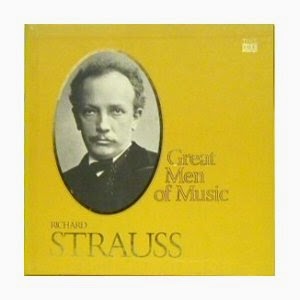
On my Leonard Pennario web log today I bragged about scoring a whole bunch of Time Life Great Men of Music at Amvets. What a haul!

Is there anything more irresistible than a big pile of classical records you do not really need? It was like Christmas. I did not want to come up to bed because I was sitting on the couch with Mahler and Strauss.

As I confided on the other web log, I love these sets for their booklets. CDs, because of their size, cannot have these luxurious booklets, with big photos to feast your eyes on, beautiful layouts that you can read comfortably while they are spread out on your lap. It fosters concentration, you know? You sit there with the booklet in your lap, or simply the record jacket in your lap, and that is where you remain, glancing at it now and then as you listen.

The Strauss record tells the story of him and his soprano wife, Pauline. It is very nicely written, by someone named Robert Jones. Did he go to Bob Jones University? Wherever he went it speaks well for their writing program, unless he is like me and just writes what comes out of his head.

Anyway, he writes about how Pauline would harangue Strauss but Strauss apparently enjoyed it, took it in some kind of humor. At the end of Strauss' life:

Back in Switzerland, Strauss battled kidney infections and coped with Pauline, whose fits and rages made them unwelcome in one hotel after another. Finally they found sanctuary at the Palace Hotel in Montreux, the only establishment willing to tolerate this extraordinary woman. Andit was there that Ricahrd Strauss composed his last tribute to music, to the soprano voice, to Pauline, and to his own life: the Four Last Songs. Amazingly, they were equal to the greatest music he ever created.

In May 1949 Strauss returned to Garmisch, having the previous year been cleared by a court in Munich of any taint of collaboration with the Nazis. Seriously ill, he was put to bed, suffering from a kidney stone that at his age was inoperable. Before he sank into his final coma he quoted a line from "Tristan": "Greet all the world for me." And to Alice Strauss, his daughter-in-law, he observed, "Dying is just as I composed it in 'Death and Transfiguration.'"

Richard Strauss died peacefully in his sleep on the afternoon of Sept. 9, 1949. He was 85. At his cremation three days later the trio from "Der Rosenkavalier" was sung.

Pauline Strauss -- that strange woman with the voice that haunted the pages of her husband's music, that termagant whom nobody but Richard Strauss understood -- lived for less than nine months after his death. At 87, on May 13, 1950, Pauline followed her faithful Richard into eternity -- in a towering rage, one likes to think, at having been kept waiting.

Beautiful.

It is funny, whenever anyone preaches to us about composers and their muses no one ever mentions Strauss and his wife. I had no idea she was that bad, you know? I mean, to be run out of hotels! But how interesting. All you hear about his Robert and Clara Schumann. I want to hear about Richard and Pauline Strauss. This booklet said he wrote that passionate song "Cacilie" the night before their wedding. To have a song like that ....


... written about you!! Wouldn't you die??

Hahaha... that pianist is scrambling ... but we get to hear Jussi Bjoerling. That high note at the end!! Have you ever heard anyone hold it that long? The guy is like a steam engine. Maestro, you go!

Where was I?

Oh yes. Anyway this is why I buy these box sets.

I will post other things I discover.


Wednesday, September 24, 2014

Paging Dr. Klemperer


My Pennario research touches on Otto Klemperer because Klemperer conducted when Pennario first performed, as a teenager, with the Los Angeles Symphony.

Anyway. Long story short, I found this from a tribute to Klemperer by Harold Schonberg:

..If the German tradition was paramount in Klemperer's approach, his intellectual background was wide enough to encompass the entire ethic of the Western world. The late Wieland Wagner once summed up Klemperer:

"Classical Greece, Jewish tradition, medieval Christendom, German Romanticism, the realism of our own time, make Klemperer the conductor a unique artistic phenomenon."

Well, yeah, I guess that just about covers it.

You have all that stuff down, I guess as a conductor you are just about set!

Apparently Klemperer as a conductor was very exacting. Schonberg tells the story of how William Steinberg recalled momentarily forgetting a couple of the tempos from Wagner's "Lohengrin," after which Klemperer held him in contempt for months. Klemperer had these extremely high standards. It is no wonder he liked Pennario.

Above is a picture of young man Klemperer. There are a bunch of them out there like that, in which he looks kind of like Gustav Mahler. Cute, you know? You are used to pictures of old man Klemperer, thus.


And thus:


No photo page of Klemperer would be complete without a shot of his son, Werner, as Colonel Klink.


Dietrich Fischer-Dieskau told a tremendous story about Otto Klemperer in his memoir "Reverberations." God, it was funny. It was about how the singers had a complaint about Klemperer's tempo in Bach. I think it was the St. Matthew Passion. And Fischer-Dieskau drew the short straw and had to bring up this delicate matter with Klemperer.

And Fischer-Dieskau had it in his head, because he was young and you do dumb things when you are young, to tell Klemperer he had dreamed that he asked God some things about the tempo. It was something like that. I will have to look it up.

In any case Klemperer snarled to him that he, too, had had a dream about God.

"And God said, 'Tell me, Dr. Klemperer, who is this Fischer?"

The greatest thing about that story is of course that God addressed Klemperer as Dr. Klemperer.

I think in heaven He is doing that now.