Friday, July 8, 2011

The music of the heart


Today I heard about a death that made me emotional. The violinist Josef Suk died. He was 81. There he is up above! I never knew what he looked like.

Suk -- you say it "souk" -- had significance to me. I wrote about it once before. He was descended from Dvorak and the composer Josef Suk but I did not care beans about that. What I cared about was that he played the version of Mozart's Adagio in E for Violin that I fell in love with when I was 14.

The reason I remember I was 14 -- I had just turned 14 -- was that it was 1976 and the classical station was playing music for the Bicentennial, music written in 1776. This glorious Adagio in E came on and I was taping it with my primitive cassette recorder. I know, nerd! I was a hoot when I was 14. I was leading this double life. None of my schoolfriends knew anything about my Mozart obsession. Well, they knew I was obsessed but they knew nothing about it.

Josef Suk played the daylights out of this piece and I will always remember hearing it for the first time. There is this one part of it so passionate and grown-up and I remember listening to it and thinking I would faint.

After that I learned the lesson in music everyone learns, that not all recordings are equal. I got somebody's recording from the record store, I forget whose, but it did not measure up.

So periodically even as I got into my 20s I would dig out that old cassette and listen to my old Suk recording.

To my delight I found it on YouTube. Well, I found one recording by Josef Suk. It is not quite the one I had, because I remember the cadenza of the one I had, and it is not this one. But it is as good.

I knew what I liked when I was 14, you know? The things I loved then, I love now. And it is funny because when you are a kid you see the world in primary colors. You LOVE this. You HATE that. Often there is no middle ground.

Back then I never knew what Suk looked like and it is strange to see him now, this square looking Czech guy with big glasses. But man, can he play.

Listening to Suk play this piece now, I can put into words what I loved about it, and still do. I like the passion he puts into it. I like how he sails and soars through it. The part I love, and I wrote about this before but I must write about it again, it starts at about 2:51. It repeats later. I am not a violinist but it seems to me what you have to do at this point is just sing your heart out. Don't hold back. I have heard other violinists who pull back and that is not the right thing to do. Suk does not. He sings out the music, and he does that consistently through the whole piece. This is a quality by the way that I love in Leonard Pennario's playing. He doesn't play stupid games with you.

It is great on a hot night like this to listen to this beautiful and passionate Adagio accompanied by a big glass of chilled white wine, as God and Mozart surely intended.

Rest in peace, Josef Suk, you wonderful musician who showed me the beauty of this wonderful piece.

Wednesday, July 6, 2011

Someone's in the kitchen with George Szell


Shows where my mind is, here I am reading the new George Szell biography by Michael Charry, and what thrills me the most?

The part about how someone noticed that Szell's music library held a copy of "The Joy of Cooking."

And it turned out Szell was friends with Irma von Starkloff Rombauer, the original author! That his her full name. I had always thought it was just Irma Rombauer. But it is not!

Charry explains that Szell liked Rombauer's German heritage, which I would concur is a most excellent thing in a woman. A friend of Szell tells him that Szell contributed some of the recipes.

Wow! Which ones?

Perhaps the Chicken Paprikash? (Or Chicken Paprika as it is called in the 1940s edition I scored at a garage sale.)

Or perhaps some of the German Christmas Cakes? Cookies are called cakes in that old edition.

Perhaps I have been cooking Szell's recipes and never knew it.

Szell is quoted as saying about Irma Rombauer: "She was living in St. Louis when I went there to conduct and we became very friendly. That was one of the reasons I went back the second year. You know how it is when people live far apart. Nothing came of it but I'm still very fond of her. Some of the recipes she got from me."

"Nothing came of it.." This book is kind of dense and gray but that is a paragraph I have pored over, I will tell you that right now. It is on page 28.

At the time they met, Charry writes, Rombauer was 54 and Szell was a young whippersnapper of 33. But the book says, "Her vivacious personality, her love for music, and her interest in cooking would have made her attractive to Szell.

Here is a picture of Irma Rombauer.


"Nothing came of it."  Hmmmm.

I guess sometimes it gets hot in the kitchen!

Tuesday, July 5, 2011

Lost in la la land


Just a couple more thoughts on "Meistersinger" and then we will move on, I promise. I think what has happened is, I never saw this opera before in its entirety, and so it has been on my mind.

It is funny how sometimes you hear something that colors your life. You wake up in the morning feeling a little different because of it. One of these days I should list some of the music that has done this to me in the past.

I did finish watching the Glyndebourne production. As I shared yesterday, it took all kinds of doing including getting up that morning at 4 a.m. -- and being late for a party later that day. Yikes, I was almost an hour late because I had to finish watching the thing before Glyndebourne pulled the plug on it.

Howard ended up watching the last scene over my shoulder. We had it on full screen. Howard always kills me. As Beckmesser was making his sorry attempt at singing the Prize Song, Howard said, "I don't know, he sounds all right to me." By the way what I wrote the other day about the name Sixtus Beckmesser, I was wrong. Beckmesser was a real actual Mastersinger, I have learned.

When the opera was over I had to scramble to explain away the last scene, the one that always gets quoted, about keeping German art sacred and pure. Awkward!

I said, "Howard, I don't want you to think I am watching Nazi opera, or anything." I explained "Meistersinger" premiered in 1868 (was it? I am in a hurry right now) and furthermore there was that speech Hans Sachs makes earlier condemning man's inhumanity to man.

Also I tried to tell him how it is supposed to be set in the Middle Ages and these Mastersingers, you know, they are these provincial tradesmen striving for something greater. They are gently comic figures. This opera is bittersweet in a kind of Mozartean way -- there was one instance where I am sure Wagner is quoting Mozart -- but it is not meant to be serious as a heart attack.

Also, I did not say this to Howard but face it, no German opera is complete without crowds of people shouting "Heil" to something. It just has to be done. I mean, look at "The Magic Flute."

OK, time to put this all to bed. But it is not easy!

This morning I realized it was time to snap out of it so while I was drinking my coffee, I looked into this new memoir that came my way, by Katherine Weber, the granddaughter of Kay Swift, who had the long affair with George Gershwin.

And there "Meistersinger" was again!

I could not get away from it!

Apparently Gershwin went with Kay Swift to see "Die Meistersinger." The book said, "He was enamored of the score."

That is fascinating! It is fun to look at "Meistersinger" through Gershwin's eyes and wonder what he took away from it.

But it is time for me to stop thinking about this.

Sunday, July 3, 2011

Nuernberg all-nighter


No one can say I do not practice what I preach! Yesterday I encouraged people to check out "Die Meistersinger" from Glyndebourne. I said I was going to even though we had less than 48 hours left to do it. And trust me, I had a lot scheduled for those hours.

I was up at 4 a.m., watching the first act!

I could not sleep because I had a lot on my mind so I thought, as long as I am good for nothing anyway, I may as well watch "Meistersinger." Anyway that is time well spent. It is one of the dumb things about the world that reading a book is looked on as being productive while listening to music in general is not.

So, somewhere around 5:30, 6 a.m., there my life is, mirroring art. Hans Sachs has been up all night and so have I!

The Hans Sachs in this production is Gerald Finley, a Canadian singer. I am not an expert on this opera, though I am fast becoming one. I had never really seen it before, not even on video. I knew parts of it and had a sketchy concept of the story. My father loved this opera and I remember when I was about 16 he sat me down and we listened to it together. I guess I liked it but I do not remember a lot more than that.

My father had a book of Wagner librettos that I inherited after he died and he had made pencil notes about the dates he listened to "Die Meistersinger." It must be written in there when exactly he and I listened to it. I will have to go look. My dad did that for one other thing that I know of. In "The Forsyte Saga," he noted down whenever he read "Indian Summer of a Forsyte." That is extremely affecting, too. So beautifully written.

I was up all night when I read "Indian Summer of a Forsyte," too! I remember when I finished it the sun was coming up.

What is this all adding up to? Darned if I know.

Back to "Die Meistersinger." I still have half of Act 3 to go but I took a break to, ahem, share my observations, should you wish to call in sick to whatever plans you had today and catch it at the last minute.

Glyndebourne set the opera in the early 19th century. It is obvious right away -- you have the top hats and the Empire waist gowns. It does not quite go with the opera's reflection of the medieval age of faith -- the night watchman calling the benediction as he calls the hours, the entire town at Mass, the hymns to and celebration of the Feast of St. John the Baptist. Also there is that last act when -- I remember the opera expert Father Owen Lee pointed this out  -- Wagner brings the Middle Ages to life as no play or movie has been able to do. You are kind of wasting that if you set the opera in a different era. "Die Meistersinger" is medieval and I can't understand why people can't leave it that way.

Still, the costumes are charming and you kind of forget they are not medieval. The opera puts you back in the Middle Ages no matter what the costumers are doing, I guess I am saying.

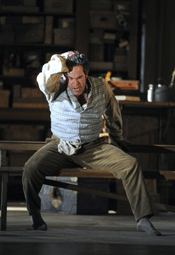
Finley, pictured up above, is tremendously moving as Sachs. He is a young Sachs. His hair is not even gray. He has a kind of pugnacious look, like a bulldog, and his ears stick out, and he's cute. Never having seen the opera before there were some things I had not realized. Sachs is kind of mean, for one thing. His apprentice is afraid of him. Sachs beats him. Sachs is wrestling with all kinds of stuff that the other people in the opera do not see.

Granted, my sleep is all over the map, and this ravishing music gets to me anyway, but I teared up watching the Prelude to Act 3. It just exposes all the secret messiness of this man's life. How he represses the memory of his dead wife -- and children, too, it seems. How he drinks too much. This might have been a Glyndebourne touch, the bottles lying around, but it rings true. Just looking at him slumped over his desk, his wine glass in his hand -- then opening the shutters and confronting the sunlight -- your heart just goes out to him. Finley shares the credit with Wagner on this one.

You hear so much, too much, about how Hitler loved "Meistersinger." Hitler must have been sleeping through the part where Sachs despairs over man's inhumanity to man. How come you never hear that quoted? I am just saying. You hear all this blah blah blah about the ending, when he talks about the sacred German art, but you never hear the other things that Sachs says.

Two other things and then I must get back to Glyndebourne because time is short.

One, Beckmesser -- this is Johannes Martin Kranzler -- pretty much steals the show whenever he is on. You cannot look away from him. He has a marvelous comic face, and something is touching about him, too. I would imagine that is important in a good Beckmesser. You do not want some cartoon, or some blatant idiot. Most of us have some kind of inner Beckmesser and Wagner was smart enough to know that.

Two, the part where Eva comes to see Sachs and she kind of flirts around with him, gently, about whether he is going to try to win her hand.... God knows how this works, but music fools around with your subconscious. And opera in general -- and Wagner in particular -- is very good about getting across people's foggy relationships with each other. Things that can't be spoken or acknowledged or put into words, that is what you get from the music.

I think I should get back to it now!

Saturday, July 2, 2011

Free Wagner


You have one more day to catch "Die Meistersinger," the complete opera, streamed from Glyndebourne.

Not to fall back on Valley Girl talk, but it is So Cool. Gerald Finley is Sachs

It really puts you there. The camera pans over the crowd. You hear the clipped British announcement to turn off your cell phone and that the taking of photographs is prohibited. So exciting!!

I have not seen the whole thing but from the half hour or so that I managed to wedge in so far, it looks great. The British have a great sense of humor and a lack of vanity that I admire. I mean a lack of vanity in the service of comedy. You see this in Britcoms. They don't care how blowsy they look, how ridiculous. In "Die Meistersinger" this quality translates into great Sixtus Beckmessers. Although the Beckmesser in this production seems to be a German, Johannes Martin Kranzle.

Sixtus Beckmesser. Wagner and his friends must have been sitting around with their beers laughing and laughing when they came up with that name. Originally I heard Wagner wanted to name the guy Hans Lick, after Eduard Hanslick, the critic who hated him.

Back to the opera. I started watching it at work the other day and got so drawn into it that when someone came up to say hello to me I just about jumped out of my skin. It is that good.

Sometime between today and tomorrow I vow to get back to it.

I must!

Thursday, June 30, 2011

My dream job


Today the Wall Street Journal has a huge story about the Naples Philharmonic in Florida getting a new executive director, Kathleen van Bergen. To be honest I am really tired of thinking about orchestras and their problems. I just am. But there is one fascinating thing in this story.

That is the job that this Kathleen van Bergen is leaving.

She is, or was, the artistic director of the Schubert Club in St. Paul, Minnesota.

The Schubert Club!

Imagine that!

Monday mornings would be less onerous if instead of going into an office like everyone else, to meet my deadlines and squabble with my supervisors, I was beginning a new work week at the helm of the Schubert Club. I would spend my days listening to Schubert. Perhaps I could call musicians and talk about Schubert. I would spearhead and implement educational programs involving Schubert.

I could spend days adjudicating whose version of "Normans Gesang" is superior, Dietrich Fischer-Dieskau's or Thomas Hampson's.

My head spins to think about it.

Just to say it. You are at a party and someone asks, "So what do you do?" And you get to take a sip of wine or beer, as the case may be, and reply: "I am the director of the Schubert Club."

How did this woman get a job like that, and why would you ever leave it?

Looking up the Schubert Club the story just gets better. They have the coveted domain name www.schubert.org. They have programs coming up featuring Susan Graham and Malcolm Martineau and -- slaver! -- Matthias Goerne and Leif-Ove Andsnes. We never get lieder in Buffalo.

What Schubert are these people performing? Let me check.

Well, now I am a little less jealous. Susan Graham is singing a "predominantly German" program with a little Schubert but also Purcell, Mendelssohn, Liszt, Duparc, Sondheim, Noel Coward, etc. Sondheim, what the heck? Why do they have to throw in Sondheim? Let these Sondheim fans have their own club.

Goerne is singing Mahler and Shostakovich. Nothing against them but ... who is supposed to be the reason for the season? Schubert!

The instrumentalists are not much better. Violinist Sarah Chang and pianist Andrew von Oeyen include no Schubert on their program. Neither do violinist Julia Fischer and pianist Milana Chernyavska. Andre Watts is playing Liszt -- probably the same program he played recently here which, while dazzling, is not Schubert.

Hmmmmm.

No wonder Kathleen van Bergen is leaving.

Perhaps I should declare my candidacy for her job.

Someone had to bring Schubert back to the Schubert Club!

Tuesday, June 28, 2011

Grouchy old man


There is a problem I have in that the things I like to listen to, I listen to over and over, and the things I like to read, I read over and over. It is not a bad thing but it is hard to find the time to do it. I wish I were a teenager again, when all I had to do was sprawl on my bed and listen to Bach.

Now I sneak in pleasures here and there.

The other day at a second-hand book sale I spent a buck on a book I get a kick out of, David Dubal's "Evenings with Horowitz."

It has been a long time since I looked at this book and there are some things I am foggy on. The book tells how Dubal's friendship with old pianist Vladimir Horowitz collapses because the Horowitzes will not let him bring a date to any of the parties. I am not sure why that is. Also I am not sure why Horowitz gets addicted to having students playing for him. Did he just want to feel like the Maestro or was it more nefarious? Probably what I should do is sit down with this book and read it cover to cover. But when? I do not even have time to dry my hair.

So what I do is, I open the book here and there, and read this and that, often when I am drying my hair, which was the mental connection there. "Evenings With Horowitz" is always fun.

I like the book for its insights into Horowitz's personality, which I think must be pretty accurate. Also, not to sound too nerdy, but I like Dubal's use of adverbs.

"Wanda ardently agreed."

"Horowitz said glumly."

"Horowitz and Wanda nodded vigorously."

That is Horowitz and his wife, Wanda, the daughter of Toscanini, up above. By the time Dubal knew them, though, they were much older.

One paragraph last night got Howard and me laughing.

Dubal wants to bring his girlfriend to a party the Horowitzes are having and he is arguing with Horowitz about it.

"You know Wanda is in charge of these things," Horowitz says. "She likes only married people. She's Catholic."


I said, "Come now, Maestro. Are Woody Allen and Mia Farrow married? And I can name other exceptions who are allowed to your parties. ..."


There was no doubt Horowitz was rather upset at this confrontation. Just then, we were called to dinner.


"We go down now. I go peepee first. After a good dinner, you will feel better."


When he returned, he sat, as always, at the head of the table, with me at his left side. During his absence, he had regained his composure and started talking about the people who had been ostracized from his life.

Hahahahahaa!

That is what cheers Horowitz up!

Well, Dubal makes the point that Horowitz was thinking of ostracizing him, making a subtle threat. But I think even besides that, Horowitz probably liked to think about the people he had ostracized. Like notches in his belt.

Gotta love him, you know?